Skip to content
Two homes on the same road can lose power in the same storm and have completely different weeks. One of them has a unit outside that starts by itself within seconds of the power dropping. The other has a generator in the garage, a gas can, and a decision to make about which breakers stay on. Here is what each one actually costs, what each one can actually carry, and how to run the numbers yourself before you call anybody.
Start with what the grid here actually does
Backup power gets sold with scary numbers, so it is worth being straight about ours. Statewide, South Dakota is one of the most reliable places in the country to be a utility customer. The U.S. Energy Information Administration found that customers in South Dakota, North Dakota, Arizona and Massachusetts averaged under two hours of service interruption for all of 2024. If you are buying a generator because you expect the lights to flicker every other week, that is not the Black Hills.
The case for backup power here is not the average. It is the tail.
In November 2025, a regional transmission event outside the local system took down the entire Black Hills Energy customer network, more than 77,000 customers, from roughly 1:40 p.m. to 8:30 p.m. That one was an inconvenience. Six weeks later a record wind event hit the Hills and it was a different animal. Black Hills Energy reported over 25,000 customers out, with nearly 11,000 still dark the following evening, while Black Hills Electric Cooperative had more than three quarters of its rural network down. Days later, roughly 2,000 customers were still without power, and utility officials described the infrastructure damage as the worst since Winter Storm Atlas in 2013.
During that December restoration, crews reported finding damage to customer owned equipment, including service masts that had to be repaired before the utility could safely re-energize the home. The utility stops at the meter. Everything on the house side of that point is on the homeowner, and it has to be fixed by a licensed electrician before the lights come back on. That is a real part of why some houses stay dark days longer than their neighbors.
So the honest framing is this: you are not buying protection from a flickering grid. You are buying a plan for the three to five day winter event that shows up every few years, when the roads are blocked, crews are coming in from other states, and your furnace, your well pump and your pipes do not care whose fault it is.
Two real options, and the names matter
There is a lot of loose language around this, including from people selling it. There are two genuinely different products.
1. A standby generator, also called a whole home generator
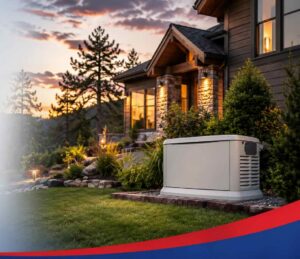
A permanently installed unit on a pad outside the house, hard piped to natural gas or propane, wired to an automatic transfer switch at the service. It monitors utility voltage, starts itself when the power drops, transfers the load, and shuts down and transfers back when utility power returns. It exercises itself on a schedule. You do not have to be home. You do not have to touch anything.
2. A portable generator connected through a transfer switch or an interlock kit
The unit you would recognize from a jobsite. Gasoline, or dual fuel on propane, wheels, a pull cord or an electric start. It gets connected to the house through a code compliant piece of equipment so that generator power and utility power can never be present at the same time. You start it, you fuel it, you shut it down, and you decide what stays on.
“Whole home” describes how a generator is connected, not a promise that everything in the house runs at once. Plenty of permanently installed systems are sized below the full calculated load of the house and use automatic load management to shed the water heater or a second air conditioning compressor before the generator ever sees it. The difference is that the machine makes that call in a fraction of a second, every time, whether you are home or in Denver.
What a whole home standby generator costs installed
National installed pricing for a residential standby system generally lands between $6,000 and $11,000 for a typical home, with the equipment itself running $3,000 to $6,000 and labor $3,000 to $5,000. Larger units and difficult sites push higher. One installer breakdown puts the range at $7,000 to $20,000, with most 22kW whole home installs landing at $10,000 to $14,000. Angi puts the standby installation portion alone at an average of about $4,520, covering permits, assembly, placement and wiring.
Rather than argue about the total, look at what the total is made of. This is where quotes actually differ.
| Line item | Typical range | What moves it |
|---|---|---|
| Generator unit | $3,000 to $8,000 | kW rating, air cooled versus liquid cooled, enclosure and sound rating |
| Automatic transfer switch | $500 to $2,500 | Service rated whole panel switch versus an essential circuit switch with load shedding. Some units ship bundled with a switch, some do not. |
| Concrete pad or composite base | $300 to $1,200 | Site access, grade, frost depth, whether you need forms and a pour or a manufactured pad works |
| Fuel connection | $500 to $3,000 | Distance from the gas meter, pipe sizing for the added load, or a new propane tank and regulator if there is no natural gas at the property |
| Conductor run, conduit, trenching | $500 to $3,000 | Distance from the pad to the service, whether it is a straight shot or a trench under a finished driveway |
| Permit and inspection | $150 to $600 | Jurisdiction. Both electrical and gas work are permitted in nearly every AHJ. Any contractor telling you a permit is not needed is a problem. |
| Service or panel work | $0 to $4,500 | An older 100A service often needs to go to 200A before a whole home system makes sense |
| Realistic all in | $7,000 to $18,000 | Most Black Hills residential installs land in the middle of this |
These are national planning ranges pulled from published cost data, not a Wires R Us quote. Every one of these lines changes based on what we see when we walk your property.
Two things worth flagging early, because they are the most common surprises. First, if your service is a tired 100A panel, a service upgrade or a panel swap may need to happen first, and that is a real cost that has nothing to do with the generator. Second, if there is no natural gas at your address, which is common outside the city limits, you are looking at a propane tank sized for multi day runtime, and that changes both the install cost and the operating math.
What a portable generator plus a transfer switch costs installed
This path is genuinely cheaper, and anyone who tells you otherwise is selling. Portable units themselves run roughly $500 to $2,500, with the useful 7,500W to 12,500W range mostly landing in the middle of that. The connection work is the part that needs a licensed electrician and a permit.
| Line item | Typical range | Notes |
|---|---|---|
| Portable generator | $500 to $2,500 | Running watts, dual fuel capability, electric start, inverter versus conventional |
| Panel interlock kit, installed | $400 to $900 | Lowest cost compliant option. Bracket hardware is cheap, most of the number is labor and the generator input breaker. |
| Manual transfer switch, installed | $400 to $2,200 | A 6 to 10 circuit switch with a dedicated mini panel sits at the top of that range |
| Generator inlet box, conduit, cord | $200 to $600 | Weatherproof inlet, conduit run, and a properly rated SOOW generator cord |
| Permit and inspection | $100 to $400 | Yes, this work is permitted too |
| Realistic all in | $1,300 to $4,500 | Interlock plus a mid size portable sits near the bottom, a 10 circuit manual switch plus a big dual fuel unit near the top |
One cost calculator pegs the single most common configuration in American homes, a 10 circuit manual transfer switch paired with a 7,500W to 12,500W portable, at $1,400 to $2,000 turnkey.
Interlock kit or manual transfer switch
Both solve the same safety problem and both are legitimate. They solve it differently, and the difference shows up in how you live with it.
| Panel interlock kit | Manual transfer switch | |
|---|---|---|
| What it is | A machined bracket on your existing panel that mechanically prevents the main breaker and the generator input breaker from being on at the same time | A separate sub panel wired between your main panel and a fixed set of circuits, usually 8 to 10 |
| Circuits you can reach | Any circuit in the panel | Only the circuits that were pre wired to it during install |
| Overload risk | On you. You must turn off non essential breakers to stay inside the generator’s capacity. | Very low. Only the pre wired circuits are available, so you physically cannot ask for more than the design allowed. |
| Outage routine | Kill the main, slide the plate, flip the generator breaker, then turn circuits back on one at a time | Flip each circuit handle from utility to generator |
| AFCI and GFCI protection | Your existing arc fault and ground fault breakers stay in the circuit | Depends on the switch and how the circuits were routed. Worth asking about. |
| Catch | Panel brand and series specific. Not every panel has a listed kit. | You are locked into the circuit choices you made on install day |
| Installed cost | $400 to $900 | $400 to $2,200 |
Interlock kits are listed for a specific panel brand and series, and roughly seven in ten residential panels have a compatible factory kit available. If you do not know what is on your wall, this rundown of the panel types found in homes is a good place to start. Some older panels have no listed kit at all, which pushes you toward a transfer switch or a panel swap.
A double male cord from the generator into a dryer outlet or a range receptacle. It energizes your panel, it energizes the service drop, and it has killed line workers who had every reason to believe the line was dead. It also backfeeds through your main breaker with nothing protecting it. Interlock kits and transfer switches exist specifically to make this impossible. There is no version of the cord trick that is worth it.
What a portable can realistically carry
This is where the comparison stops being about money. Motor loads draw far more to start than to run, and that surge is what decides whether your generator carries the house or trips.
| Load | Running watts | Starting surge |
|---|---|---|
| Refrigerator | 150 to 400 | 800 to 1,200 |
| Chest freezer | 150 to 400 | 800 to 1,200 |
| Gas furnace blower and inducer | 300 to 900 | 500 to 2,400 |
| Well pump, 1/2 to 3/4 HP | 400 to 1,500 | 1,800 to 3,000 |
| Sump pump | 800 to 1,050 | 1,300 to 2,000 |
| Lights, router, phones, a TV | 400 to 600 | Negligible |
| Microwave | 1,000 to 1,500 | Negligible |
| Well pressure tank plus water heater on gas | 300 to 600 | 1,500 |
| Central air, 3 ton | 3,500 to 4,500 | Often double the running figure |
| Electric water heater | 1,100 to 4,500 | None, but it is a continuous hog |
| Electric dryer | 4,500 | Brief motor surge on top |
| Electric range, single element | 1,500 to 3,000 | None |
Ranges compiled from published appliance wattage data, including manufacturer sizing guidance and appliance load tables. Check the nameplate on your own equipment. These are planning numbers.
Run a realistic Black Hills winter list on a 7,500W portable. Furnace blower at 700, refrigerator at 300, freezer at 300, well pump at 900, lights and electronics at 500. That is 2,700 running watts, which sounds like plenty of headroom. Then the well pump kicks on while the furnace is already running and you are briefly asking for 2,700 plus a 2,500 watt surge. You are still fine. Now add a microwave and a space heater and you are hunting for the breaker in the dark.
What does not fit on a 7,500W unit: central air conditioning plus much of anything else, an electric dryer while the well is running, or an electric water heater at all. Published guidance is consistent that a 7,500W generator can cover essentials and one significant motor load, and that an electric dryer or a central air condenser will overload it if you stack them on top of the essentials. If you want central air during an outage, plan on 10,000 watts or more, and at that point you are into the largest portables and the price gap starts closing.
How to estimate this yourself before you call anyone
You should be able to walk into a quote with your own number. Here is how we would do it if we were you.
Sizing a portable
- Write down only what runs at the same time. Not everything you own. The furnace, the fridge, the freezer, the well, the lights, one small kitchen appliance.
- Add the running watts. Use nameplates where you can, the table above where you cannot.
- Add the single largest starting surge, once. Two big motors starting in the same instant is possible but planning for it makes you buy a generator you do not need. Size for the biggest one.
- Target 80 percent of the generator’s running rating, not the starting rating. The big number on the box is surge. The number that matters is continuous.
- Check the 240 volt loads separately. A well pump or a furnace on 240V needs the generator to actually have a 240V outlet with enough capacity on that leg, which not every portable does.
Sizing a standby
This one is code driven, and that is a good thing because it means there is a defensible answer instead of a sales number. NEC Article 702 governs optional standby systems, and 702.4 requires that the system either have capacity for all the loads it is intended to serve, or that automatic load management equipment prevents overload. In practice there are three legitimate paths:
- Full Article 220 load calculation. Square footage, appliance nameplates, demand factors. It is the most conservative and usually produces the biggest generator.
- Historical peak demand. If the house exists and has a smart meter, twelve months of actual interval data gives you the real peak the house has ever pulled. This is almost always a much smaller number than the Article 220 result, and it is a recognized method. It does not work on a house that has not been built yet.
- Automatic transfer switch with load management. Load management under Article 750 lets a smaller generator legally serve a whole home, because the system sheds the air conditioning or water heater before the generator sees the load. This is how a 22kW unit legitimately covers a house whose calculated load says otherwise.
The single most expensive mistake homeowners make is sizing the generator to match the panel. A 200A service at 240V is 48,000 watts on paper. No house draws that. Matching the panel buys you a generator two sizes too big, and an oversized unit that never sees 50 percent load has its own problems with carbon and deposits.
The Black Hills number that is not in any online calculator
Every nameplate rating on every generator sold is a sea level number. Air gets thinner as you go up, combustion suffers, and the unit makes less power. Manufacturer spec sheets for air cooled home standby units state it plainly: maximum power decreases approximately 3.5 percent for each 1,000 feet above sea level, and roughly another 1 percent for each 10 degrees F above the rated ambient temperature.
Now apply that here. Downtown Rapid City sits at about 3,202 feet. Deadwood starts around 4,531 feet and climbs from there, and Lead is higher still.
| Location | Approximate elevation | Altitude derate | What a 22kW nameplate actually delivers |
|---|---|---|---|
| Belle Fourche | about 3,000 ft | about 10.5 percent | roughly 19.7 kW |
| Rapid City, Sturgis, Piedmont, Spearfish | about 3,200 to 3,650 ft | about 11 to 13 percent | roughly 19.2 to 19.6 kW |
| Deadwood | about 4,500 ft | about 16 percent | roughly 18.5 kW |
| Lead | about 5,100 ft | about 18 percent | roughly 18.1 kW |
Derate figures calculated from the published 3.5 percent per 1,000 feet factor. Elevations are approximate town center figures and vary considerably by lot, especially in the northern Hills. Confirm the actual site elevation and the manufacturer’s own derate curve for the specific model before sizing.
This is not a rounding error. A homeowner in Lead who sizes off an online calculator and buys a 22kW unit is buying something closer to 18kW of real capacity, and if the load calculation said 20kW, that system is going to trip on a January evening with the furnace and the well both calling. This applies to portables too, at roughly 3 percent per 1,000 feet. It is one of the reasons we do not quote generator sizes off a phone call.
Fuel and runtime, which is where the paths really separate
The purchase price is a one time conversation. Fuel is the conversation you have on day three.
Natural gas standby
If you have natural gas at the property, runtime is effectively unlimited as long as utility gas pressure holds. There is nothing to refill and nothing to store. This is the best case scenario and it is why natural gas units dominate in town.
Propane standby
Common outside the city limits, and it is a tank sizing question. A 500 gallon tank is filled to 80 percent under NFPA 58, so about 400 usable gallons. A 22kW unit at a realistic 50 percent household load burns roughly 1.8 to 2.0 gallons per hour, which works out to somewhere around 8 days of continuous runtime on a 500 gallon tank. Shut it down overnight and that stretches considerably. Most homes average well below 50 percent load during an outage, so real world runtime is usually better than the arithmetic suggests. The thing to plan for is that during a widespread outage, propane delivery gets delayed too.
Portable gasoline
A 7,500W portable with a 6 to 8 gallon tank runs roughly 10 to 12 hours at 50 percent load, and 6 to 8 hours at full load. Do the math on a five day outage. That is somewhere between ten and twenty refuels, in December, in the dark, with stations that may be down themselves and pumps that need power to run. You also need to have stabilized fuel on hand before the storm, because you will not be buying it during.
The CPSC reports that an average of about 100 people die every year in the United States from carbon monoxide poisoning caused by portable generators, and their guidance is unambiguous: outside only, at least 20 feet from the house, never in a garage, basement, shed or carport, and opening a door or window does not fix it. In a Black Hills blizzard, “20 feet from the house and out of the wind” is a harder problem than it sounds, and that is exactly when people make the decision that kills them. If you go the portable route, work out where that machine lives during a storm before the storm, and put a CO alarm on every level of the house.
Our honest read on the tradeoff
There is a popular version of this argument that goes: you are already paying for a transfer switch and you already have to pick and choose what stays powered, so you might as well go whole home and stop thinking about it. We understand the appeal. We do not think the cost half of that argument holds up, and we would rather tell you that than win a sale with math that does not survive a calculator.
The transfer switch is not where the money is. An interlock or a manual switch is a few hundred to a couple thousand dollars, which is somewhere around ten to twenty percent of a standby install. A portable plus a compliant connection lands around $1,300 to $4,500. A standby system lands around $7,000 to $18,000. That is not a small step up you might as well take. That is a real decision with real money in it, and pretending otherwise insults your intelligence.
The portable path is not worse. It is a different product that asks a different price, and the price is partly paid in labor and availability instead of dollars. Choosing it means committing to being home, awake, and willing to work in weather. It stops making sense the moment any of those three assumptions breaks, and it stops making sense financially once you start buying your way around them: a bigger portable to carry the well and the furnace together, a 10 circuit switch instead of an interlock, a dual fuel conversion, a storage plan, an electric start, a cover. Stack those and you are at half the cost of a standby system with none of the automation.
The portable path is genuinely the right call if
- Your outages are usually hours, not days
- Someone is home during most of the year
- You are on city water and gas heat, so your critical loads are small and manageable
- You are comfortable working a panel correctly, every time, under stress
- The budget is the constraint and something is better than nothing, which it absolutely is
Skip straight to standby if
- You are on a private well. No power means no water, and no water in winter starts a different set of problems
- Your heat depends on electricity to run, and a multi day loss means frozen pipes rather than a cold night
- Anyone in the house depends on medical equipment
- You travel, or you are gone for stretches in winter
- You work from home and an outage costs you income
- You are building. More on that below
The frozen pipe point deserves its own sentence, because it is the one that changes the arithmetic. A generator is expensive. A house that loses heat for three days in January in the northern Hills is a claim, a restoration crew, and months of your life. That risk is not evenly distributed across our service area, and it is a bigger deal in Lead and Deadwood than it is in Rapid Valley.
If you are building, the timing is the whole game
The cheapest generator install is the one that happens while the walls are open and the yard is already torn up. During construction, the pad location, the gas stub, the conduit run, the transfer switch location and the load calculation all get handled once, in coordination with the other trades, with no demolition and no restoration. Retrofit means trenching a finished lawn, working around a finished driveway, and sometimes re-doing gas pipe sizing that was never intended to carry a generator.
Even if a generator is not in this year’s budget, roughing in for one during the build is inexpensive insurance. A conduit and a gas stub to a future pad location costs a fraction of what it costs to add them in five years. We do a lot of new construction electrical for builders across the Black Hills, and this is one of the easiest conversations to have early and one of the most expensive to have late.
Not sure which side of this you land on? We will look at your service, your fuel situation, your actual load and your site elevation, and give you a straight number for both options.
Talk to Wires R UsFrequently asked questions
Is a whole house generator worth it?
It depends almost entirely on your critical loads and how long your outages last, not on how much you dislike being inconvenienced. If you are on a private well, heat with something that needs electricity, or cannot be home reliably, a standby system solves a problem a portable cannot. If you have city water, gas heat and someone home, a portable and a properly installed interlock covers the same outage for a quarter of the money. Resale is sometimes cited as a justification. Treat that as a bonus, not a reason.
Is an interlock kit or a transfer switch better for a portable generator?
An interlock kit is cheaper, installs faster, uses your existing panel, and lets you reach any circuit in the house. The tradeoff is that managing the load is on you, and the kit has to be listed for your specific panel brand and series. A manual transfer switch costs more, limits you to the circuits it was wired for, and makes overloading nearly impossible because those are the only circuits available. Interlock for flexibility and price, transfer switch for simplicity under stress.
What size generator do I need for a whole house?
Most homes land somewhere between 14kW and 22kW, but the honest answer is that it comes from a load calculation, not a square footage rule of thumb. NEC Article 702 requires either full capacity for the loads served or automatic load management to prevent overload, and there are three legitimate ways to get there: an Article 220 calculation, twelve months of actual metered peak demand, or a smaller generator paired with a load management transfer switch. In the Black Hills you then have to derate for elevation, which most calculators do not do.
What will a 7,500 watt generator actually run?
Essentials plus one significant motor load. A gas furnace blower, a refrigerator, a freezer, a well pump, lights and electronics fit comfortably with headroom for surge. What does not fit is central air conditioning, an electric dryer, or an electric water heater stacked on top of that. If you want central air during an outage, plan on 10,000 watts or more.
Can I just plug my generator into my dryer outlet?
No. A double male cord energizes your panel and your service drop, which puts utility line workers at risk of electrocution and backfeeds through your main breaker with nothing protecting it. It also has no way to prevent utility power and generator power meeting. Interlock kits and transfer switches exist to make this physically impossible, and both cost less than the liability of the alternative.
How much does it cost to install a whole house generator?
Published national ranges put a complete residential standby install between roughly $6,000 and $20,000, with most typical homes landing in the $10,000 to $14,000 area for a 22kW system. The largest swing factors are the distance from the pad to your service and gas meter, whether natural gas is available at your address, and whether your existing service needs upgrading first. Get a line itemized quote so you can see which of those is driving your number.
Do I need a permit to install a generator or a transfer switch?
Yes, for both paths. Generator installs involve permitted electrical work and, on a standby unit, permitted gas work as well. Interlock kits and manual transfer switches are permitted electrical work too. Any contractor who tells you no permit is required is telling you something useful about how they operate.
Will a generator protect my electronics when the power comes back?
Not by itself. Utility restoration after a major storm is a common source of voltage surges, and a transfer switch handing the load back to the grid does nothing to filter that. That is a separate piece of equipment. We wrote about whole home surge protection and management if you want the detail.
Where to go from here
If you want to talk through your specific situation, our generator installation page covers what our process looks like, and we serve homeowners and builders across the Black Hills. If you are still deciding between backup power options in general, our solar, EV and generator overview lays out how these systems relate to each other.
And if the reason you are reading this is that a breaker keeps tripping and you are wondering whether a generator is even the right conversation, it probably is not. Start with why a bigger breaker is not the answer instead.