Skip to content
Having an understanding of how the electrical panels in your home work will help you recognize the signs of a potential problem and maintain a safe and reliable electrical system.
Types of Electrical Panels Found in Homes
Primary Electrical Panels
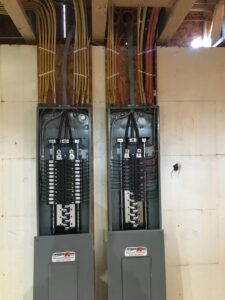
- Main breaker panels – These are the most common types of electrical panels in homes today because they can accommodate various kinds of circuits, thanks to a combination of the main breaker and multiple circuit breakers.
- Fuse boxes – These are outdated but still function well in homes with fewer electrical demands. They’re difficult to maintain because they contain fuses, which must be replaced once they are blown, instead of breakers.
- Load centers – These panels operate better in smaller structures. They are safe, easy to reset, and code-compliant.
- Transfer switch panels – These panels connect to two sources of power – one usually being the main electrical grid – and switch between them as needed to ensure there’s a constant flow of electricity through your home.
- Smart panels – These panels operate like standard electrical panels while allowing you to track your power usage.
Secondary Electrical Panels
- Main lug panels – These distribute electricity to specific areas of a property and are shut down by primary panels further up the electrical circuit because main lug panels don’t have main breakers.
- Subpanels – These may contain a main breaker depending on your needs. They’re often installed in structures that are detached from your home.
Is My Electrical Panel Safe?
To ensure your electrical panel is keeping up with safety standards, ensure you:
- Stay on top of NEC (National Electrical Code) updates.
- Learn which electrical panels are safety hazards:
- Federal Pacific electrical panels with Stab-Lok breakers
- Zinsco panels
- Older fuse boxes
- Examine the panel box for damage that could be caused by overheating or moisture.
- Flip each breaker on and off to ensure they’re resetting properly.
Watch out for these issues on the electrical panel in your home:
- Abnormally frequent breaker trips and blown fuses
- Visible corrosion, rust, or water damage
- Old and uninspected
- Warm to the touch
And these red flags around your home:
- Constant humming, crackling, or buzzing sounds
- Bulbs that constantly flicker or dim
- Dangerous-smelling or looking outlets
Electrical Panels That Have Been Recalled
Federal Pacific Electrical (FPE) Panels
Despite being a notorious fire risk, FPE panels with Stab-Lok breakers were never recalled. Not even after an investigation by the CPSC (Consumer Product Safety Commission) revealed that a little over half of the Stab-Lok breakers didn’t trip when they were overloaded, or when it came out that FPE cheated during the UL (Underwriters Laboratory) certification process.
Risks and Replacement Options
The reputation of FPE panels is so well known that most insurance providers will not cover you if you have one installed in your home, and most electricians will recommend that you replace them for your own safety.
There are two possible replacement options:
- A complete panel upgrade – Any UL-listed electrical panel will do. Square D, Eaton (Cutler-Hammer), or Siemens panels are decent options.
- Retrofit your panel – You can use an Eaton retrofit kit to convert your FPE panel to a Bryant (BR) or Cutler-Hammer (CH).
It may be a bit costly, depending on the state of your wires and the location and code-compliance (or possible lack thereof) of your FPE panel, but an upgrade will guarantee your home’s safety. It should also:
- Increase the capacity, reliability, and energy efficiency of your electrical panel
- Increase your property value
- Lead to reduced insurance premiums
- Future-proof your home
Zinsco/GTE-Sylvania
Zinsco panels are just as notorious as FPE panels, and they were never recalled either. They are known for having bus bars that corrode easily and have insecure connections with their breakers (which melt into their bus bars when the panel overheats).
Challenger
Challenger panels are safer, but there have been two instances when they were recalled.
The first was in 1988, after a removable mechanical component was discovered as a source of overheating, and the second was in 2014, when easily accessible components on 1,000 panels proved to be shock risks.
Schneider Electric/Square D Panels
These panels have only been recalled once. Between February 2020 and January 2022, it was discovered that 1,000 panels with a Square D label and a date code that fell between 194871 and 221343 had loose neutral screw connections that could overheat and cause a fire.
If you’re worried about your electrical panel or think it might need an upgrade, contact the Wires R Us team, and we’ll have someone out to look it over and advise you.