Skip to content
Weather in the Black Hills can be unpredictable. One day it’s calm and sunny; the next you’re hit by an intense storm that knocks out your power. It’s part of the reason whole-home generators in Rapid City are quickly becoming less a nice-to-have luxury and more of a standard, and often needed, upgrade.
The Benefits of a Whole-Home Generator in Rapid City
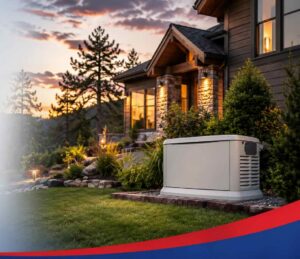
Whole-home generators are permanent outdoor fixtures that connect directly to your electrical system. While they are on the pricier side ($12,000–$18,000+) and can take up a lot of space, they are reliable.1
A good-sized whole-home generator can keep the most critical systems in your home powered during an outage, meaning you don’t have to worry about food in your fridge going off or your pipes potentially freezing in winter. An automatic generator will do this even when you’re not home. Its automatic transfer switch will transition your electrical system from the grid to your generator within seconds of sensing the power has gone out.27
Fuel Options for Whole-Home Generators
Most residential standby generators in our area run on natural gas or propane, so when deciding on your generator, you’ll also need to consider the fuel option that’ll work best for you.
Natural gas is convenient when it’s available because the fuel supply is continuous. Propane, on the other hand, is extremely common in the Black Hills region. It works very well for rural properties, cabins, and homes outside city utility areas. And while it can become less reliable when temperatures hit less than -44°F,3 that hasn’t happened since 1994.4 As long as you’ve got a properly sized propane system, it shouldn’t struggle during winter.
You’ll need to look at the size of your home, its load requirements, and which fuel is more readily available in your area before you make a final decision.
Winter Protection
Power outages are never great, but they can be costly and even dangerous in winter as problems arise one after another:
- Furnaces stop running. Depending on how cold it is, this can be one of the biggest problems during a power outage in winter.
- Refrigerators and freezers warm up. This is an inevitable issue that can lead to your food spoiling if an outage isn’t resolved quickly enough.
- Heat tape stops working. This can cause your pipes to freeze and eventually burst, which can cause your basement to flood — especially when combined with a non-operational sump pump.
- Well pump stops operating. This will either cause your water supply to drop to a trickle or immediately shut off.
A frozen pipe can cause tens of thousands of dollars in damage.5 We’ve seen situations where homeowners were away during a storm, the power went out, temperatures dropped, and by the time someone discovered the issue, the house already had major water damage.
A whole-home generator can protect your home from this situation.
Portable Generators vs. Whole-Home Generators
Portable generators are excellent budget-friendly solutions for those who need them. They’re great as temporary backups for occasional outages, and if you just want to power select circuits in your home.
However, there are trade-offs:
- You must be home to use them
- Requires manual setup
- Requires fuel storage
- Extension cords or manual transfer equipment are needed
- Not ideal for elderly homeowners
- Not ideal for second homes or rentals
- Can become difficult during severe weather
- You can’t do anything about a power outage if you’re away
There’s also an important safety consideration. Portable generators must never be used indoors or in partially enclosed spaces — they produce carbon monoxide, an odorless, colorless gas that can be deadly.6 That’s why many homeowners tend to lean toward whole-home generators instead.
Proper Installation Matters
A generator is one of the most critical electrical systems in a home because it directly interfaces with the utility service and powers major systems during emergencies.
If they’re not installed properly, a best-case scenario is just dealing with performance issues. The worst-case scenarios can include fire risks, electrical hazards, and even carbon monoxide poisoning. In other words, the installation team cannot cut corners.
If you need a team that’s certified to install whole-home generators in Rapid City, Wires R Us is an excellent option. Give us a call, and we’ll send someone to evaluate your home and suggest the best setup for you.
References
- Angi. “Whole House Generator Cost [2026 Data].” angi.com/articles/how-much-does-it-cost-install-generator.htm
- Norwall Power Systems. “Automatic Transfer Switches for Standby Generator Systems.” blog.norwall.com/generator-information/automatic-transfer-switches-standby-generator-systems
- Central Penn Propane. “What Happens to Your Propane Tank in Extreme Cold: Myths vs. Facts.” centralpennpropane.com/what-happens-to-your-propane-tank-in-extreme-cold-myths-vs-facts
- South Dakota Public Broadcasting. “South Dakota’s Top Ten All-Time Coldest Temperatures.” sdpb.org/rural-life-and-history/2024-02-20/south-dakotas-top-ten-all-time-coldest-temperatures
- Travelers Insurance. “Does Homeowners Insurance Cover Burst Pipes?” travelers.com/resources/home/insuring/does-homeowners-insurance-cover-burst-pipes
- Centers for Disease Control and Prevention. “Carbon Monoxide Poisoning Basics.” cdc.gov/carbon-monoxide/about/index.html
- Cummins Inc. “Automatic Transfer Switch — Home Generators.” cummins.com/en-na/na/generators/home-standby/automatic-transfer-switch