Skip to content
Don’t ignore the box on the side of your house. Your electric meter is the single best source of information about how your home uses power, and knowing what it says can help you cut costs, protect your systems, and plan for solar.
What the meter measures (quick)
At its core, an electric meter records how much electricity your building uses. That measurement is shown as kilowatt-hours (kWh), watts multiplied by time. So a 60 W bulb run for 24 hours uses 1.44 kWh (60 × 24 ÷ 1,000).
Meters report consumption in two broad ways:
- Total energy used (what older mechanical meters show), and
- When and how you use it (what modern digital or “smart” meters capture).
How meters work: mechanical vs. digital (short & simple)
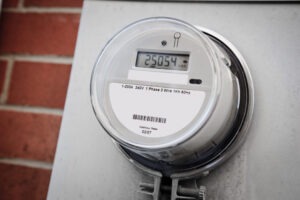
Mechanical (analog) meters use a spinning metal disc linked to dials; the faster it spins, the more power you’re pulling. Digital meters use sensors and electronics to measure voltage and current and show the reading on a display. Smart meters are digital meters with communications, they push frequent readings to the utility automatically.
If you’re curious, you can still read a mechanical meter yourself (note: read dials right-to-left and follow the usual rules when a pointer sits on a number). But with smart meters you don’t need to, the utility gets the data remotely.
Pricing, rates, and why the meter matters
Modern meters enable more granular pricing structures:
- Time-of-use (TOU): electricity costs more during peak hours and less during off-peak.
- Demand charges: you’re billed based on peak power drawn at any moment.
- Net metering: your meter measures power both taken from the grid and exported back (useful for solar).
Because smart meters record when you use power, they make it possible to shift consumption to cheaper hours and avoid costly demand spikes. That’s powerful for homeowners and essential for anyone installing solar.
Solar and the meter
Going solar often means the utility will swap in a meter that can register two-way flow. With net metering, excess solar production can earn you credits, sometimes running the meter “backwards.” If you already have a capable smart meter, you may not need a swap; your installer and utility will confirm.
Accuracy, disputes, and standards
Meters must meet accuracy requirements set by standards bodies and utility regulators. In the U.S., meters are tested against ANSI standards (accuracy classes like 0.1, 0.2, 0.5). If you suspect a problem, utilities can compare your meter to a test (a check meter or laboratory calibration), proven misreads usually result in a refund for the affected period. American National Standards Institute
Health & safety
Smart meters emit low-power radiofrequency signals. These are non-ionizing and far weaker than many everyday devices. Major health agencies have not found convincing evidence that RF from meters causes cancer. For context and the most current health guidance, consult your local public health resources.
Practical tips
- Ask your utility what type of meter you have and whether they provide usage data or an app.
- If you’re on TOU rates, shift heavy loads (EV charging, laundry, pool pumps) to off-peak hours.
- Avoid simultaneous heavy draws (oven + HVAC + EV charger) to reduce demand charges.
- If you’re considering solar, have your installer check whether your meter needs to be changed for net metering.
- If a bill looks wrong, request a meter test, utilities will investigate and, if needed, correct billing.
(For national context on meter adoption and utility programs, official energy agencies track smart meter rollouts and program rules.)
Need help understanding your electric meter or planning an electrical upgrade?
The team at Wires R Us can review your system, explain your energy usage, and recommend solutions to improve efficiency and reliability. Contact Wires R Us today to schedule a consultation.