Skip to content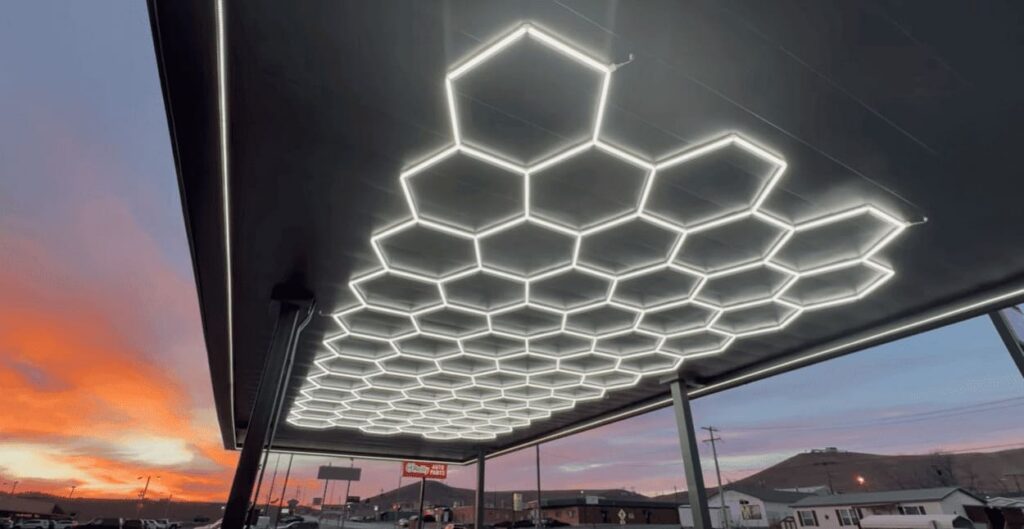
A hexagon LED lighting installation can transform a dim overhang into a space people notice the moment they pull up. The finished result looks simple, but getting there involves a surprising number of judgment calls about layout, wiring, and power that never show up once the lights are on. On a recent job in Rapid City, our crew completed a full hexagon LED array along a building overhang and filmed the process from start to finish. Here is what actually went into it.
Planning the Layout
Before any fixture went up, the hardware itself got a small upgrade. Every mounting screw was painted black ahead of time so it would not stand out against the dark surface underneath the overhang once everything was installed. It is a small step in any hexagon LED lighting installation, but it pays off the moment the lights come on and nothing pulls the eye toward bare, shiny hardware.
The bigger decision was where to center the whole array. One option was to measure off the building line and the edge of the overhang. The other was to center everything on the building’s middle support pole instead. Centering strictly on the building line would have thrown the array visually off to one side, so the crew centered on the middle pole instead, which reads as balanced from the ground even though it is not the mathematical center of the structure. A laser level then projected that center mark straight down, giving an exact, repeatable reference point for positioning every fixture in the array consistently.
Wiring and Power Distribution
This particular fixture system uses two different types of connectors depending on where a given fixture sits in the run. Fixtures at the very end of a line use connectors without copper contacts, since no power needs to continue past them, while every other fixture in the run uses a different connector style built to pass power through to the next unit. Getting this detail right is one of the less visible parts of a hexagon LED lighting installation. Mixing those up is an easy mistake to make and a hard one to catch later, since it will not necessarily announce itself until part of the array doesn’t light up correctly.
Rather than feeding the whole array from a single point, this system pulls power from roughly six separate locations spread across the run. That is a deliberate design choice, not a workaround. Long chains of LED fixtures fed from only one end can experience voltage drop, which may reduce the voltage available to fixtures farther from the power source and can lead to uneven brightness. Spreading power delivery across several points along the run keeps every fixture in the array at a consistent brightness instead of fading toward one end.
Once everything was hooked up and energized, the crew checked the actual current draw rather than assuming the math would hold up in the field. The array drew about 16 amps on a circuit breaker rated for 30 amps, which leaves plenty of headroom rather than running the circuit near its limit. That margin matters for a lighting load that will run for hours every night, since a circuit sized with no buffer at all is far more likely to cause nuisance trips down the road.
The payoff showed up immediately. The array brought noticeably more light into a space that had been dim before, the black painted hardware blended in cleanly instead of catching the eye, and passersby were commenting on how good it looked before the crew had even finished packing up. When the first vehicle pulled through that evening under the new lighting, it was clear the layout decisions made earlier in the day had paid off.
If your business could use a similar upgrade, Wires R Us offers hexagon LED lighting installation as part of our lighting upgrade services, available through our commercial electrical division. Reach out to our commercial team to talk through layout, power planning, and what a clean installation could look like for your property.