Skip to content
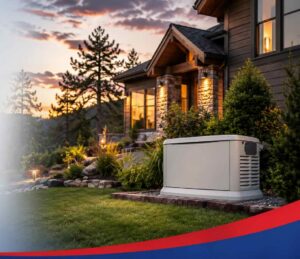
A home standby generator is a permanently installed unit that runs on natural gas or propane and starts automatically when utility power fails. A transfer switch moves the house over to generator power on its own, usually about thirty seconds after the outage begins, and moves it back when the utility returns.
Short answers
- Fuel: natural gas where distribution mains run, propane nearly everywhere else in the Black Hills.
- Sizing: driven by your 240 volt loads, above all the well pump, not by square footage.
- Heat: a propane or natural gas furnace still needs house power to run, so heat is usually the first load to cover.
- Placement: set by fuel distance, service distance, exhaust clearance, and where snow drifts.
- Timing: plan it before storm season, because demand spikes the week after every major outage.
Outages here are not brief. In December 2025, over twenty five thousand Black Hills Energy customers lost power in one night, with nearly eleven thousand still out the next afternoon, and the rural cooperative reported three quarters of its network down. Town comes back first. The farther you sit from a main feeder, the longer you wait. We handle standby generator installation throughout the region, and this is what the decision actually involves.
How the transfer switch works, and why it matters
The transfer switch senses the outage, waits roughly thirty seconds, then starts the generator and moves the house over. The delay exists because power rarely fails cleanly in a storm, and you do not want an engine cycling through every flicker.
It is also a safety device. A properly installed transfer switch physically prevents your generator from backfeeding the utility lines, which protects the line crews working to restore them. That is why a generator is never connected through a cord into a receptacle, and why utilities repeat the warning about never running a portable unit indoors or in an attached garage.
Natural gas or propane
Your address decides this. Natural gas is the better option where distribution mains already run, since the supply is underground and never needs refilling. Outside those areas, propane is the practical choice and the tank is often already on site feeding a furnace or water heater.
Propane is more energy rich per gallon than natural gas, which is why the same unit publishes a higher output rating on propane. Check which fuel a spec sheet is quoting before you compare two models.
The catch with propane is that you own the supply. A large unit under load empties a tank faster than people expect, and during a February outage the furnace and water heater draw from that same tank. Tank size belongs in the sizing conversation, not after it.
Sizing: start with the loads, not the generator
Sizing is determined by which loads you want running during an outage. The heavy 240 volt loads set the number: well pumps, air conditioning, electric ranges, electric dryers and electric water heaters. Lighting and receptacles barely register beside them.
Three loads matter most on properties in this region:
- Heat. A gas furnace still needs electricity for the blower, igniter and controls. A full propane tank keeps you exactly as warm as an empty one when the power is out.
- Water. On a private well, no power means no water at all. The pump is frequently the single most important load in the house and it is a heavy one.
- Food. The refrigerator and the chest freezer in the garage.
Bigger is not better. A larger unit burns more fuel per hour and costs more to install. Match the unit to the loads you intend to run.
Your existing service is part of the answer. If the panel is full or the service is undersized for what the house already does, that gets handled first. Older homes in Deadwood, Lead and the established parts of Rapid City hit this often, since the service was sized for a house without a heat pump, a shop or a car charger on it. Sometimes the right first step is an electrical panel replacement, sometimes a service upgrade to 200 amp.
Where the generator can go
Placement is set by four things, and it affects cost directly, since a longer run to the service means larger conductors under NEC ampacity rules.
- Distance to fuel. A short pipe run is simpler and cheaper than a long one.
- Distance to the electrical service. Longer runs mean larger conductors and more labor.
- Exhaust. A running engine produces carbon monoxide, so the unit cannot sit where exhaust can reach an operable window, a door, a dryer vent or a fresh air intake.
- Snow. A unit under a dumping roofline or on the drift side of the house gets buried in exactly the conditions you bought it for.
Maintenance
Standby units exercise themselves on a weekly schedule, running a short cycle of several minutes to circulate oil and prove the engine starts. Set that schedule for a time you are home, so you hear it. Beyond that: oil and filter changes on run hours, commonly around one hundred, plus the calendar schedule in the manual. Keep an eye on the starting battery, since cold weather is what finishes off a marginal one. Check the status indicators occasionally, because nothing tells you about a fault if nobody looks.
Storm season is also the right time to look at whole home surge protection, since restorations are hard on electronics.
Check your service mast after a wind event
If the mast carrying utility conductors into your meter is bent or pulled loose, the utility cannot restore power to your house even after the line is fixed. That repair is the homeowner’s responsibility and requires a licensed electrician. After a serious wind event, walk outside and look at where the wires meet the house.
Why we will not quote one over the phone
The price depends on what nobody can see from a desk: available fuel and its distance, what the existing service and panel can handle, which loads you want covered, where the unit can safely sit, and whether the well pump is in the plan. Two houses on the same road land in different places. We would rather look at it and give you a figure you can plan around.
Talk to us about backup power
We install and service whole home standby generators along with solar, EV and generator electrical systems, as electricians serving communities across the Black Hills and Rapid City.
Common questions
How long does a standby generator take to start after the power goes out?
About thirty seconds. The transfer switch waits a short delay before calling for the generator, which keeps the unit from cycling during brownouts and brief flickers. The engine then runs a few seconds to reach full speed before the house transfers over.
Is propane or natural gas better for a home standby generator in the Black Hills?
Natural gas where distribution mains already run, propane nearly everywhere else. Natural gas never needs refilling. Propane is more energy rich per gallon, which is why units list a higher rating on it, but you own the supply, so tank size becomes part of the sizing decision.
What size standby generator do I need for my house?
It depends on which loads you want running, not on square footage. The heavy 240 volt loads drive the answer: well pumps, air conditioning, electric ranges, electric dryers and electric water heaters. A home on a private well almost always has to account for the pump, and a home with gas heat and gas cooking needs far less capacity than an all electric home of the same size.
Will a generator run my furnace if I heat with propane?
Your furnace needs electricity regardless of what it burns. The blower, igniter and control board all run on house power, so a gas furnace produces no heat during an outage without a source of electricity. That is why heat is usually the first load homeowners here want covered.