Skip to content
Why New Homes in Rapid City Need a 200A Service for EV Readiness
Practical load math, code context, and why the cheapest moment to plan for an EV charger is before the drywall goes up.
If you’re building a new home anywhere in the Rapid City area — Black Hawk, Piedmont, Summerset, or out toward Spearfish — the question of electrical service size deserves more thought than it usually gets. For decades, 100A and 150A services were standard. They still pass inspection on plenty of plans today. But the math has changed, and the biggest reason is the EV charger.
If you intend to ever charge an electric vehicle at home, or you want the option to do so later without tearing into your service equipment, a 200A service is the practical floor for a new build.
EV Chargers Are Continuous Loads — That Matters
The National Electrical Code (NEC) classifies electric vehicle supply equipment as a continuous load (NEC Article 625). Continuous loads have to be sized at 125% of their nameplate rating per NEC 210.19(A) and 215.2(A).
In plain numbers:
- A 32A Level 2 charger requires a 40A circuit.
- A 40A charger (common for Tesla Wall Connector, ChargePoint Home Flex on its higher setting) requires a 50A circuit.
- A 48A charger requires a 60A circuit.
That 48A charger draws 48 amps continuously at 240V — roughly 11.5 kW. On a 100A service, you’ve just dedicated almost half your home’s capacity to one circuit before you’ve turned on a single light.
The Load Calculation Reality on Modern Homes
NEC 220.82 (the optional method for one-family dwellings) gives a structured way to calculate service size. When you run an honest load calculation on a typical new build in this area, the totals add up faster than people expect:
- Central HVAC (heat pump or electric backup)
- Electric range or cooktop
- Electric dryer
- Electric water heater (if not gas)
- Dishwasher, disposal, microwave
- General lighting and receptacle load (3 VA per square foot per NEC 220.41)
- And now — an EV charger
On a 2,400 sq ft home with electric appliances and a 48A EV charger, that calculated load lands well into 200A territory. Trying to fit it into a 100A panel either fails the calculation or forces compromises: smaller charger, undersized service equipment, or a load management device added later to throttle the EV when the rest of the house is drawing heavily.
Why “Just Upgrade Later” Is the Expensive Path
Upgrading a service after the home is finished isn’t a small change. It typically involves:
- A new meter socket and main panel
- Potentially a new service entrance conductor
- Utility coordination to drop and re-energize the service (Black Hills Energy or West River Electric, depending on territory)
- Local permitting and inspection
- In some cases, drywall and trim work to relocate or expand the panel area
At the new-construction stage, the difference between specifying a 100A and a 200A service is mostly the cost of the panel, the meter base, and slightly heavier service conductors. The labor is the same crew on the same day. After the home is built, you’re paying for that work twice.
Local Context: Why This Matters in the Black Hills
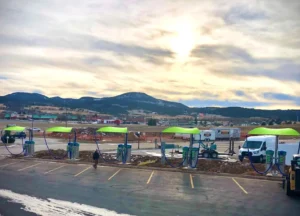
EV adoption in the Black Hills region was slow to start, partly because the distances between towns are real and the winters are cold — both of which affect EV range. But the charging infrastructure has filled in considerably. Public DC fast chargers now exist along I-90 and in Rapid City itself, and home charging is increasingly the assumed setup for any EV owner who doesn’t want to plan their week around public stations.
Cold weather is also a reason to size up, not down. EVs charge more slowly in low temperatures, and battery preconditioning draws additional load. A properly sized service gives the charger the capacity to do its job without competing with the heat pump or the well pump.
What We Recommend on New Builds
On any new home we wire in the Rapid City area, we encourage builders and homeowners to plan for:
- A 200A service as the baseline for any home with central electric HVAC or any EV charging intent.
- A dedicated 50A or 60A circuit roughed in to the garage, even if the charger itself isn’t being installed yet. Conduit from the panel to the garage wall costs very little at framing stage.
- Coordination with the AHJ (authority having jurisdiction) on the current adopted NEC edition. South Dakota and local jurisdictions update on their own cycle, so the head electrician on your project should always confirm the active edition.
None of this is exotic work. It’s load math done honestly at the design stage, before you’ve boxed yourself into a service that the house will outgrow.
Sources & Further Reading
- U.S. Department of Energy — Charging at Home
- Alternative Fuels Data Center (U.S. DOE) — Electricity Charging Infrastructure
- Alternative Fuels Data Center — Public Charging Station Locator
- National Fire Protection Association — NFPA 70 (National Electrical Code)
- SAE International — SAE J1772 (EV Conductive Charge Coupler)
- Black Hills Energy — Service Information
- City of Rapid City — Permitting and Building Services
This article is informational. Specific load calculations and code compliance for any project should be performed by a licensed electrician based on the NEC edition currently adopted by the applicable jurisdiction.