Electrical Work at the Center of It All: What Belle Fourche Properties Actually Need
Belle Fourche sits at the geographic center of the nation and the northern edge of the Black Hills. The properties here have their own set of electrical demands, and cookie cutter solutions rarely fit.
Belle Fourche carries a distinction most towns never earn. It sits at the geographic center of the United States, a fact locals know well and one that quietly captures something true about the place. This is a working town. It has ranching roots that go back generations, an energy industry presence, and a housing stock that ranges from older in-town homes to large agricultural properties spread across the surrounding land. The electrical needs here reflect all of that, and they are different enough from a Rapid City subdivision or a Spearfish canyon cabin that they deserve their own conversation.
We serve the Belle Fourche area and have worked on properties across this part of the state. Here is what we actually see when we show up to work here.
Agricultural Properties and the Loads That Come With Them
A significant number of properties in and around Belle Fourche are working ranches or hobby farms. These are not residential loads in the traditional sense. You have well pumps, grain handling equipment, irrigation systems, heated outbuildings, livestock facilities, and shops that need to power welders, compressors, and other heavy tools.
Well pumps alone change the service sizing conversation. A 1HP submersible draws 10 to 12 amps at 240V in normal operation with a startup surge several times that figure. Under NEC Article 430, motor loads require their own sizing treatment and cannot simply be folded into a general estimate. On a ranch property with multiple motors, a shop, a residence, and any intent to add EV charging or a standby generator, the load calculation needs to be done honestly from the ground up.
Detached shops and outbuildings on these properties should have their own dedicated feeder and subpanel rather than a single circuit run from the main panel. NEC 250.32 requires ground-neutral separation for detached structures, and a properly sized subpanel gives the building the capacity to handle whatever work actually happens inside it. Running that feeder while the ground is already open for other work costs a fraction of what it costs to come back and do it later.
Generator Backup Is Not Optional Out Here
In a city, a power outage is an inconvenience. On a ranch or agricultural property in the Belle Fourche area, it is a real operational problem. Livestock systems, well pumps, heating equipment, and refrigeration all depend on power, and the distance from town means that utility restoration can take longer than it would in a denser service area.
Belle Fourche falls within West River Electric Association territory for many properties outside the city limits, and anyone who has lived here through a winter storm understands that backup power is a legitimate priority. A properly installed standby generator with an automatic transfer switch keeps critical systems running without requiring anyone to go outside in a blizzard to start a portable unit.
The time to plan for a generator is during new construction or a service upgrade, not after the fact. That means coordinating the transfer switch location, generator pad, and fuel supply before the flatwork is poured and the walls are closed. Retrofitting all of that into a finished structure is doable, but it costs significantly more and involves more compromise than doing it right the first time.
Older Housing Stock and the Service Upgrade Question
Belle Fourche has a substantial inventory of older in-town homes. Many of these were built when 60A or 100A services were considered adequate, before central air conditioning, electric ranges, multiple refrigerators, home offices, and EV chargers became part of everyday residential life.
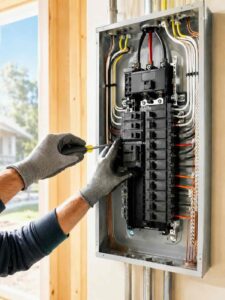
An undersized service does not just limit what you can run. It can create safety issues, cause breakers to trip repeatedly, and make it impossible to add circuits for modern needs without first addressing the service itself. A service upgrade to 200A on an older Belle Fourche home is often the first step that makes everything else possible, from a panel swap to an EV charger install to a generator connection.
These upgrades require coordination with the utility, local permitting, and an inspection. We handle all of that as part of the process, and we do it cleanly enough that inspectors and homeowners both notice the difference.
New Construction on the Northern Edge of the Black Hills
Belle Fourche sits at the northern gateway to the Black Hills, and new construction here tends to reflect that position. Properties are larger, distances between structures are greater, and owners often want infrastructure that can support a working property long term, not just a residence that passes inspection today.
Voltage drop is a real consideration on long runs. The NEC recommends keeping it under 3% on branch circuits, and on a 200 foot run to a shop or outbuilding with undersized wire, you can hit that limit before the circuit reaches its destination. The fix at rough-in is upsizing the conductor. The fix after the walls are finished and the yard is landscaped costs considerably more.
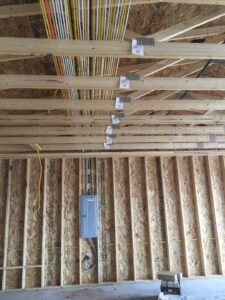
On new builds in this area we plan for service size, long run conductor sizing, generator infrastructure, and EV charging capacity at the framing stage. These are not expensive additions when they are planned from the start. They become expensive when they are retrofitted into a finished building.
What We Bring to Belle Fourche
We are not a company that sends a crew out to do the minimum the plan requires and moves on. The properties in Belle Fourche demand more than that, and the people who own them know the difference between work that is done right and work that just passes inspection. Our crews leave job sites clean, our work is organized and easy for inspectors to follow, and we communicate clearly throughout the project so nobody is guessing about what is happening or when.
Belle Fourche has been at the center of this region for a long time. The electrical work going into its properties should reflect that same standard.
Sources & Further Reading
- National Fire Protection Association — NFPA 70 (National Electrical Code)
- U.S. Department of Energy — EV Charging at Home
- West River Electric Association — Member Service Territory
- Black Hills Energy — Service Area Information
- City of Belle Fourche — Permitting and Building Services
- Butte County — County Planning and Zoning
This article is informational. Specific load calculations and code compliance for any project should be performed by a licensed electrician based on the NEC edition currently adopted by the applicable jurisdiction.