...

What New Construction in Spearfish SD Actually Demands

Wiring a Growing City: What New Construction in Spearfish SD Actually Demands

Spearfish is one of the fastest growing cities in South Dakota. Here is what that growth means for electrical planning on new builds.


Spearfish has changed a lot in the last decade. What was once a quieter college town anchored by Black Hills State University has become one of the most in-demand places to live in the entire state. New subdivisions are pushing out from the city core, canyon-side cabins and vacation properties are being built at a pace the area hasn’t seen before, and the I-90 corridor has brought commercial and retail development that keeps general contractors consistently busy.

All of that growth creates a specific set of electrical demands. The homes going up in Spearfish today are not the same as what was being built here fifteen years ago, and the electrical planning needs to reflect that.

New Subdivisions and the Service Size Question

Spearfish’s residential growth has brought a wave of new subdivision builds on the edges of town. These are modern homes, and modern homes carry modern loads. Central heat pumps, electric appliances, home offices, smart home systems, and increasingly, EV chargers in the garage.

The National Electrical Code classifies EV supply equipment as a continuous load under NEC Article 625, meaning circuits must be sized at 125% of the charger’s nameplate rating per NEC 210.19(A). A 48A charger needs a 60A circuit and draws roughly 11.5 kW continuously. Stack that on top of a heat pump, an electric range, and a dryer, and a 100A service runs out of headroom fast.

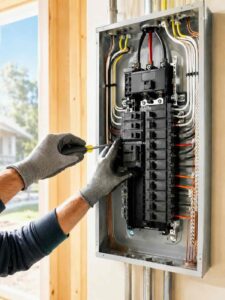
On any new subdivision build in Spearfish, a 200A service is the practical baseline. It is not an upgrade. It is what the load calculation honestly requires on a fully loaded modern home.

Canyon Properties and Cabin Builds Are a Different Challenge

Spearfish Canyon draws people who want something more than a subdivision lot. These are custom builds, often on steep or wooded terrain, with longer service runs, unique access considerations, and owners who expect the finished product to perform at a high level.

Distance is the first issue. A canyon cabin set back from the road or accessed by a long private drive can involve service runs that most city electricians never think about. Voltage drop accumulates over distance, and the NEC recommends keeping it under 3% on branch circuits. On a 200-foot run with undersized wire, you hit that limit before you reach the panel. The fix at rough-in is upsizing the conductor. The fix after the walls are finished costs significantly more.

These properties also tend to have generator backup as a real priority, not an afterthought. Canyon roads can become difficult to access in winter, and owners who spend significant money on a property expect the lights to stay on when Black Hills Energy has a service interruption. Planning the transfer switch location, generator pad, and fuel supply during the build is far simpler than retrofitting all of it into a finished structure.

Acreage and Hobby Farm Properties on the Outskirts

Push a few miles out from Spearfish and the properties change character again. Larger lots, detached shops, well pumps, outbuildings, and owners who want the electrical infrastructure to support a working property, not just a residence.

Well pumps are a load that gets underestimated consistently. A 1HP submersible draws 10 to 12 amps at 240V in normal operation with a startup surge several times higher. Under NEC Article 430, motor loads get their own sizing treatment and cannot simply be folded into a general load estimate. A property with a well, a shop, central HVAC, and an EV charger needs a load calculation that accounts for all of it honestly.

Detached shops on these properties also deserve their own subpanel and feeder rather than a single circuit from the main panel. NEC 250.32 requires ground-neutral separation for detached structures, and a dedicated subpanel gives the building room to grow into whatever it actually ends up being used for. Running that feeder while the ground is already open costs a fraction of what it costs to trench and pull wire after the yard is finished.

Commercial Growth Along I-90

The I-90 corridor through Spearfish has seen consistent commercial development, and general contractors working in that space have specific expectations of their electrical subcontractors. Schedules are tight, inspections matter, and work that is not done cleanly creates problems down the line for everyone on the project.

Our reputation in the Black Hills commercial space is built on showing up when we say we will, leaving a clean and organized job site, and producing work that inspectors and GCs can rely on. Contractors in Spearfish who have dealt with subcontractors that don’t communicate, miss deadlines, or leave sloppy work know exactly what that costs a project. We built our business on being the answer to that problem.

What We Bring to a Spearfish Build

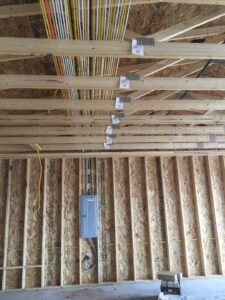
Whether the project is a new subdivision home, a canyon cabin, an acreage property, or a commercial job along the interstate, the fundamentals are the same. Honest load calculations done at the planning stage. Service sized for what the home will actually become. Infrastructure roughed in for EV charging and generator backup before the walls close. Long runs sized for voltage drop, not just for the minimum the plan requires.

Spearfish is growing fast. The electrical work going into these buildings needs to keep up with what the city is becoming, not just what it was.


Sources & Further Reading

This article is informational. Specific load calculations and code compliance for any project should be performed by a licensed electrician based on the NEC edition currently adopted by the applicable jurisdiction.

Ready to work with a team that values cleanliness, reliability, craftsmanship, and efficiency?

Seraphinite AcceleratorOptimized by Seraphinite Accelerator
Turns on site high speed to be attractive for people and search engines.